воскресенье, 30 января 2011 г.

Gavials (Bangladesh) - гавиалы (Бангладеш)


It's a good occasion to know more about these creatures.
Those are some interesting facts I could find
- * Their special features are long and very narrow noses
- * Gavials live in Hindustan
- * They are very bad at moving on the ground but they are the quickest of all the crocodiles while in the water
- * In gavials' bellies the human remains are often found. It was thought that was because they eat humans. But now the scientists explain the fact differently: gavials swallow the remains of cremated bodies that are buried according to the old traditions in the waters of the Ganges river.
- * Gavials are considered endangered species and need protection.
Сегодня сделала себе подарок - купила в местном клубе серию марок Бангладеш WWF с гавиалами
Когда-то я обожала смотреть "охотников за крокодилами" на канале Animal Planet, поэтому не могла устоять против соблазна купить марки.
Ареал обитания этих милых носатиков - север Индостана. Их исключительная особенность - очень длинные узкие морды. На конце морды у самцов вырастает такой своеобразный нарост-мешок, из-за которого собссно, этих красавцев и истребляют, потому что эти наросты считаются афродизиаками
Гавиалы плохо приспособлены к передвижению по суше, а вот по скорости передвижения в воде им почти нет равных.
В их желудках иногда находят останки людей. До недавнего времени гавиалы пользовались дурной славой людоедов, но изучив их, учёные пришли к выводу, что они просто заглатывают останки кремированых тел, которых по старинному обычаю люди в тех краях хоронят в водах Ганга.
Вот такие марки с крокодилами.)
пятница, 28 января 2011 г.
Levitsky Dmitry - Дмитрий Левицкий - 250 лет со дня рождения

Выпуск из двух марок России, посвященный 250-летию Российской Академии Художеств и 275 летию со дня рождения Д.Г.Левицкого
Russian Postal emission of 2 stamps to the 250 year anniversary of D.Levitsky.
He was a Russian Ukrainian portrait painter.
The author of the stamps is A. Povarikhin
On one stamp there is a self-portrait painted by Levitsky in 1783
On the other stamp - portrait of G.Alymova
Glafira Ivanovna Alymova (1758-1826) was a Russian lady in waiting to Catherine the Great and one of the first Russian harpsichordists
среда, 26 января 2011 г.
Government House. Belarus - Дом Правительства. Беларусь

the official postcard from Belarus

BY-130186
It's interesting to note
* the Government House was built in 1929-1934
* It 's a monument to the constructivizm era
* It's still one of the biggest buildings in the country
* Nearly all the building was built by hand: the constructors did not have diggers, bulldozers, pillar cranes. The foundation pit was dug by hand too. The ground was taken away in small carts.
* In front of the building you can see the monument to Vladimir Lenin.
понедельник, 24 января 2011 г.
Isaac Ilyich Levitan

A postal emission of Russia of 2010
A postal block devoted to the great Russian artist Issak Levitan. (1860-1900)
He is thought to have become the first painter of the Russian scenery who revealed all its beauty.
There is something in his landscapes that reflects our own moods.
On the block you can see his painting "Fresh Wind. The Volga"
Below there are some of his most famous paintings.
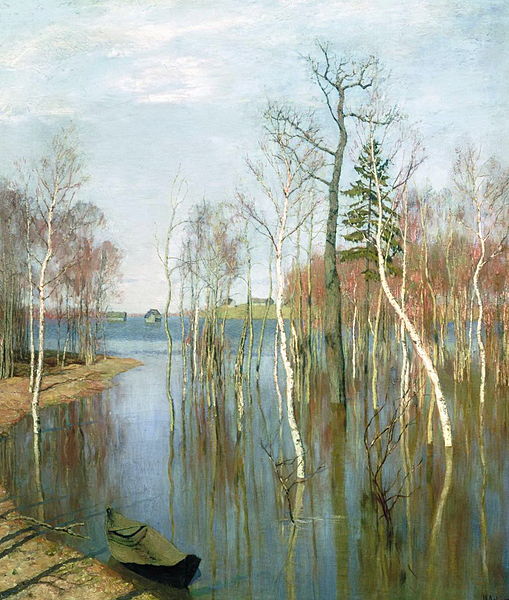
Spring. High Water
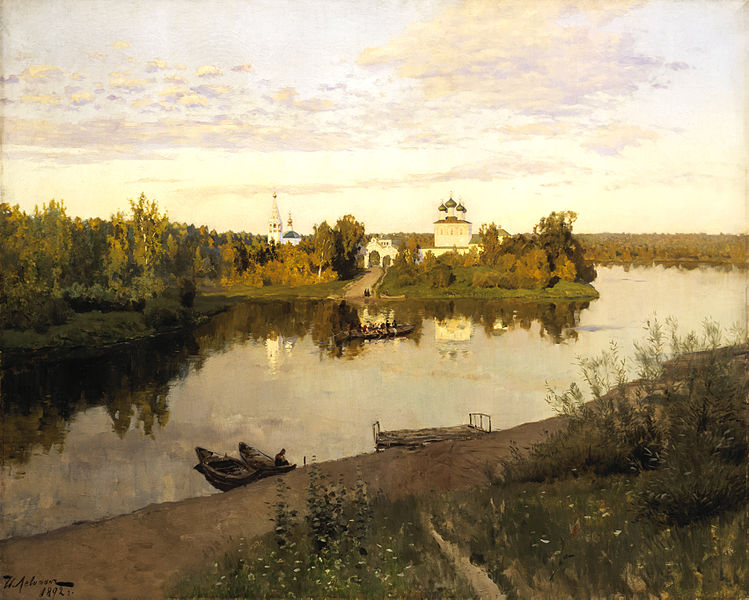
Evening bells, 1892
It is interesting to note that the master of landscape, he never introduced figures into it. Though if you look at the Autumn Day in Sokolniki — everything seems to bring out the loneliness of the figure in the centre: the trees losing their leaves, the remote, indifferent sky, the path going off into the distance. But the fact is that it was not Levitan who painted the figure. It was Checkov's brother Nicolai who did it. But all the other parts of the canvas belong to Levitan's brush.

Autumn Day in Sokolniki
вторник, 18 января 2011 г.
Riga - Рига

Riga at night
postcard from antra86
Riga was a major centre of the Hanseatic League, deriving its prosperity in the 13th–15th centuries from the trade with central and eastern Europe. The urban fabric of its medieval centre reflects this prosperity, though most of the earliest buildings were destroyed by fire or war. Riga became an important economic centre in the 19th century, when the suburbs surrounding the medieval town were laid out, first with imposing wooden buildings in neoclassical style and then in Jugendstil. It is generally recognized that Riga has the finest collection of art nouveau buildings in Europe.
Подписаться на:
Сообщения (Atom)